The Water Challenge Facing Arizona Homeowners
You know that sinking feeling when you open your July water bill.
It is a common experience for almost everyone living in the Valley.
Water rates in the Phoenix metro area are climbing, and the pricing structures are designed to penalize heavy users. In recent years, providers like EPCOR and the City of Phoenix have utilized tiered rate structures or allowance-based pricing. This means once you cross a certain gallon threshold, the cost for every subsequent drop skyrockets.
We see the data firsthand.
For the average Arizona homeowner, landscape irrigation isn’t just a small part of the budget. It accounts for up to 70 percent of total household water use.
The good news is that technology has finally caught up to our desert climate.
Modern smart controllers, paired with efficient delivery systems like pressure-compensating drip irrigation, can reduce your outdoor water usage by 40 to 60 percent compared to traditional timer-based sprinkler systems. For many homeowners in Surprise, Phoenix, and the surrounding areas, this translates to savings of $800 to $2,000 per year on water bills.
This guide explains how smart irrigation works, what components you need, and how the investment pays for itself faster than almost any other home improvement.
What Makes an Irrigation System “Smart”
A traditional irrigation controller is essentially a clock with a timer.
You program it to turn on specific zones for specific durations on specific days. It runs that same schedule regardless of whether it rained yesterday, whether temperatures are 65 or 115 degrees, or whether your plants are dormant or actively growing.
We call this the “set it and forget it” trap.
A smart irrigation controller replaces that rigid, one-size-fits-all approach with dynamic, responsive scheduling. Here is what sets smart systems apart:
Weather-Based Scheduling (ET Controllers)
The most common type of smart controller uses evapotranspiration (ET) data to calculate exactly how much water your landscape needs on any given day.
Think of ET as the rate at which your landscape sweats.
It measures how much water evaporates from the soil and transpires from plant leaves based on temperature, humidity, wind speed, and solar radiation.
Weather-based smart controllers access real-time weather data through WiFi connections to local weather stations or built-in sensors. They automatically increase watering during hot, dry, windy periods and reduce or skip watering during cool, cloudy, or rainy conditions. In the Phoenix metro area, summer water needs can be 400 percent higher than winter needs. This dynamic adjustment prevents the massive overwatering that happens when homeowners forget to adjust their manual timers.
Soil Moisture Sensors
Some smart systems incorporate soil moisture sensors buried in your landscape beds.
These sensors measure actual moisture levels at the root zone and communicate with the controller in real time. The controller only activates irrigation when soil moisture drops below a target threshold. This ensures plants receive water only when they actually need it.
We find this particularly effective for our clay-heavy Arizona soil.
Because our soil holds water well, surface dryness often deceives homeowners into watering too soon. Without soil sensors, even a weather-based controller may overwater drought-adapted species like Texas Sage or Mesquite.
Flow Monitoring
Advanced smart controllers include flow sensors that measure the volume of water passing through your irrigation main line.
These sensors act as a 24/7 security guard for your plumbing.
They detect abnormal flow rates that indicate a broken pipe, stuck valve, or broken sprinkler head. When a leak is detected, the system automatically shuts down and sends an alert to your phone. A single broken 1/2-inch poly line can waste over 300 gallons per hour. Leak detection alone can save Arizona homeowners hundreds of dollars in a single afternoon.
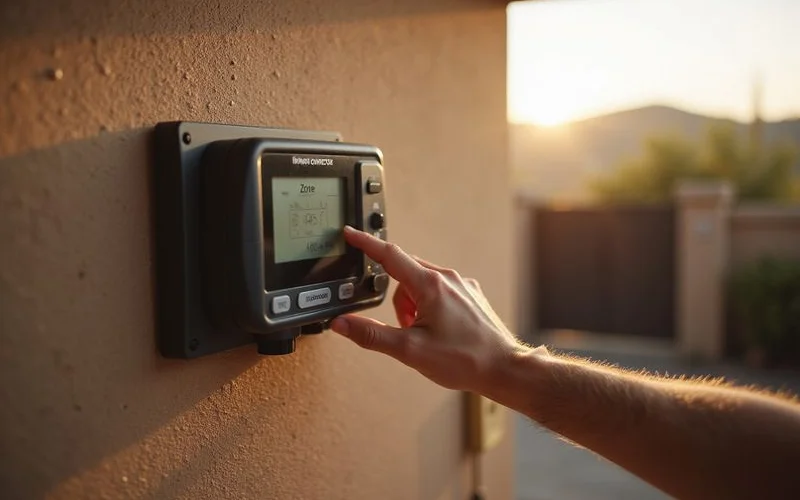
Top Smart Irrigation Controllers for Arizona
We have tested and installed dozens of smart controller models across the Phoenix metro area.
Experience has taught us which units survive the intense heat and which ones fail. Here are the systems we recommend most frequently:
Rachio 3
The Rachio 3 is our go-to recommendation for most residential installations.
It supports 8 or 16 zones and connects to your home WiFi. It uses hyperlocal weather data from stations often located within your own neighborhood to create weather-intelligent schedules.
The companion app is the standout feature here.
It is intuitive and allows you to monitor and adjust your system from anywhere. The Rachio 3 is EPA WaterSense certified and qualifies for many Arizona water rebate programs.
Hunter Hydrawise
The Hunter Hydrawise is an excellent option for homeowners who want a professional-grade controller with smart capabilities.
It integrates seamlessly with Hunter’s line of rotors, spray heads, and drip components. The predictive watering algorithm accounts for forecasted rain up to 48 hours out.
This is critical during our monsoon season.
While other controllers might wait for rain to fall before skipping a cycle, Hydrawise can look ahead and pause watering before the storm hits. This prevents the soggy mess of sprinklers running during a downpour.
Rain Bird ESP-TM2 with LNK WiFi Module
Rain Bird’s ESP-TM2 with the LNK WiFi module is a strong choice for larger properties with up to 22 zones.
Rain Bird’s deep history in commercial irrigation gives this system robust reliability. The app provides detailed water usage reporting that helps you track your conservation progress.
Controller Comparison Table
| Feature | Rachio 3 | Hunter Hydrawise | Rain Bird ESP-TM2 |
|---|---|---|---|
| Best For | User-friendly App | Pro-Level Control | Large Properties |
| Monsoon Prep | Reactive Skip | Predictive Forecast | Rain Sensor Add-on |
| Interface | App-First | Touchscreen | Dial & App |
Many Arizona water providers offer rebates for installing EPA WaterSense-certified smart controllers. Check with your local water utility (such as SRP, EPCOR, or the City of Surprise) before purchasing. Some offer rebates up to $250 that can offset a significant portion of the controller cost.
Pairing Smart Controllers with Efficient Delivery Systems
A smart controller is only as effective as the delivery system it operates.
Upgrading from traditional pop-up sprinklers to more efficient delivery methods amplifies your water savings. We often see smart controllers attached to broken, leaking lines, which negates the benefits entirely.
Drip Irrigation
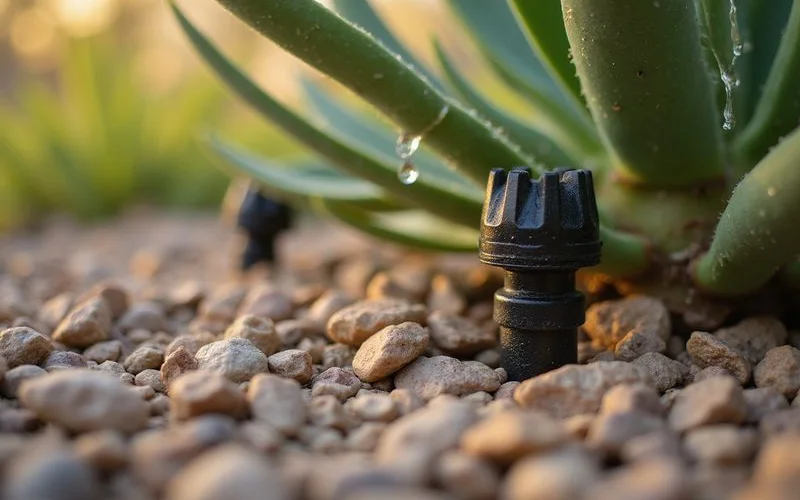
Drip irrigation delivers water directly to the root zone of each plant through low-flow emitters.
This eliminates the overspray, evaporation, and wind drift that plague traditional sprinkler systems. In the Arizona climate, where midday evaporation rates are extreme, drip irrigation acts like a surgical tool compared to a blunt instrument. It can reduce water consumption by 30 to 50 percent compared to spray sprinklers for the same plantings.
We install pressure-compensating (PC) emitters exclusively.
These devices deliver consistent flow rates regardless of elevation changes or distance from the water source. This is vital in Arizona, where calcium buildup from hard water can clog cheaper, non-compensating emitters.
High-Efficiency Rotary Nozzles
For turf areas where sprinklers are necessary, high-efficiency rotary nozzles are a game changer.
Manufacturers like Hunter produce MP Rotators that deliver water at a rate that matches the soil’s absorption capacity. Traditional spray heads apply water much faster than most Arizona soils can absorb.
This leads to the “runoff river” you often see flowing down gutters.
Rotary nozzles apply water 4 to 6 times more slowly. This allows full absorption into our compact soil and reduces runoff to near zero.
Subsurface Drip Irrigation
For the ultimate in water efficiency, subsurface drip irrigation (SDI) buries drip tubing 4 to 6 inches below the surface.
This eliminates surface evaporation entirely and delivers water directly to the root zone. SDI is particularly effective for artificial turf areas where a small amount of subsurface moisture helps cool the turf.
It is also excellent for large planting beds.
Surface drip lines can be visually distracting and are prone to damage from rabbits or landscaping tools. Burying the lines solves both problems.
Real Water Savings: What to Expect
Based on our installations across the Phoenix metro area, the savings are measurable and significant.
Here are the typical water savings homeowners experience after upgrading to a smart irrigation system:
Traditional timer + spray sprinklers (baseline): Most homes use 15,000 to 25,000 gallons per month for landscape irrigation during summer.
Smart controller + existing sprinklers: Upgrading only the controller typically reduces consumption by 20 to 30 percent. This saves 3,000 to 7,500 gallons per month.
Smart controller + drip conversion: Converting appropriate zones from sprinklers to drip and adding a smart controller typically reduces consumption by 40 to 60 percent. This saves 6,000 to 15,000 gallons per month.
Smart controller + drip + native plants: The combination of smart technology, efficient delivery, and drought-adapted plantings can reduce outdoor water use by 70 to 80 percent compared to a traditional turf lawn with timer-based sprinklers.
At current Phoenix-area water rates, these savings translate to $600 to $2,400 per year, depending on your property size and current water usage.
The Installation Process
A complete smart irrigation upgrade typically involves several steps.
We have refined this process to ensure minimal disruption to your property.
Assessment. We audit your existing irrigation system. Our team tests coverage patterns, checks for leaks, and evaluates your landscape’s actual water requirements zone by zone.
Design. We create a custom irrigation plan that assigns appropriate delivery methods to each zone. Turf areas may retain upgraded sprinkler heads, while shrub beds and desert plantings are converted to drip.
Installation. We install the new smart controller, replace or upgrade sprinkler heads, and install drip zones. We also add soil moisture sensors where appropriate and connect the system to your home WiFi network.
Programming. We set up the controller’s weather station connection. Our technicians configure plant types and soil types for each zone and establish initial schedules. The system then adjusts automatically going forward.
Training. We walk you through the app. You will learn how to monitor water usage and understand how to make seasonal adjustments if needed.
Schedule your smart irrigation upgrade during the fall or winter months (October through February) when water demands are lower. This gives you time to dial in the system before the intense summer watering season begins, maximizing your first-year savings.
Invest in Smart Irrigation Today
A smart irrigation system is one of the fastest-returning investments you can make in your Arizona home.
The combination of reduced water bills, healthier plants, and the convenience of automated, weather-responsive scheduling makes it a decision that pays for itself within one to two years.
We want to help you stop wasting water and start saving money.
At Surprise AZ Landscaping, we design and install smart irrigation systems throughout Surprise, Phoenix, Scottsdale, and the greater Maricopa County area. Contact us for a free irrigation consultation and water audit.

Written by
Alfred D. Mills
Founder & Licensed Landscape Contractor
Alfred D. Mills founded Surprise AZ Landscaping over a decade ago with a mission to bring premium desert landscaping to the Phoenix metropolitan area.
Arizona State Landscape License