Why Arizona Homeowners Are Switching to Backyard Greens
You know how frustrating it is to lose your touch on the putting surface just because you haven’t been to the course in a week.
Arizona is undeniably a global golf capital, boasting over 300 courses. Yet, for many residents in Surprise, Scottsdale, and Phoenix, the drive to the club isn’t always feasible.
A backyard putting green solves this problem. It offers the ultimate convenience of practicing your short game just steps from your patio.
Modern synthetic turf technology has evolved significantly. It now replicates the ball roll, speed, and reception of a championship course.
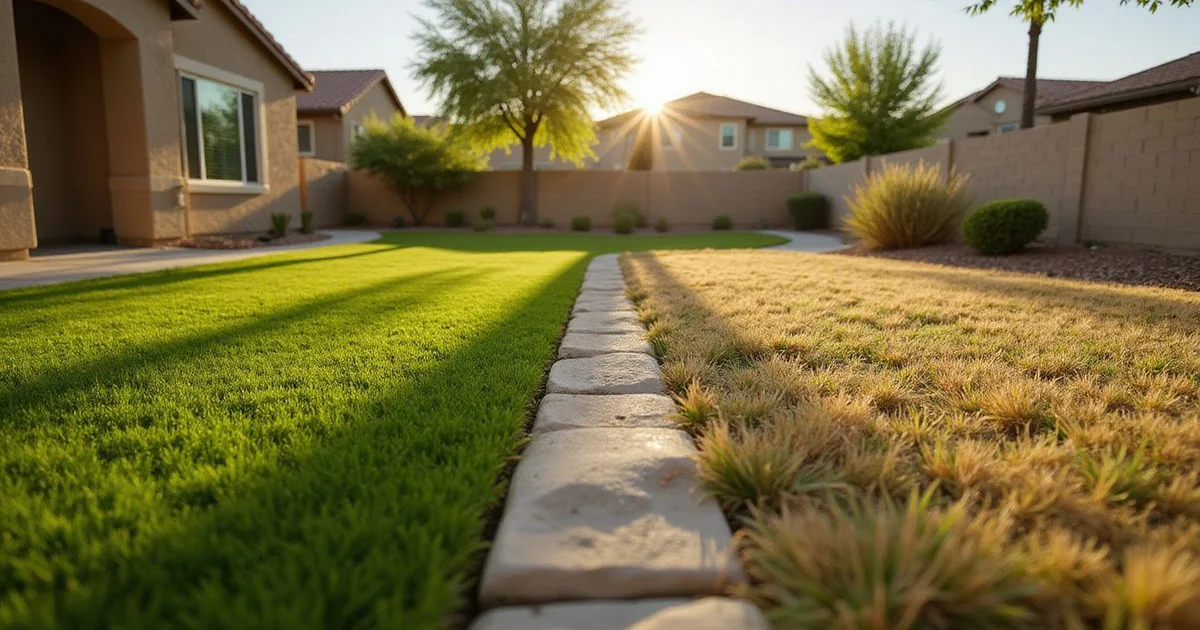
Water conservation is another major factor here.
With Arizona facing Tier 1 water shortages, switching from a thirsty natural lawn to a synthetic green reduces your outdoor water usage by an estimated 50 to 70 percent.
This guide breaks down the specific planning, pricing, and installation details you need for a successful project in the Valley of the Sun.
Planning Your Putting Green
Size and Shape Considerations
We see backyard greens ranging from compact 200-square-foot practice corners to massive 1,500-square-foot complexes.
Your available space dictates the design, but functionality should drive the layout.
Here are the common configurations we install in Maricopa County:
- The Compact Practice Green (200 to 400 sq ft): Features 2 to 3 holes. This size is perfect for side yards or smaller patios in master-planned communities.
- The Standard Gamer (400 to 800 sq ft): Features 3 to 5 holes. This allows for contoured terrain with gentle breaks.
- The Short Game Complex (800 to 1,500+ sq ft): Features 5 to 9 holes. These often include chipping mats, sand traps, and extended fringe areas for pitch shots.
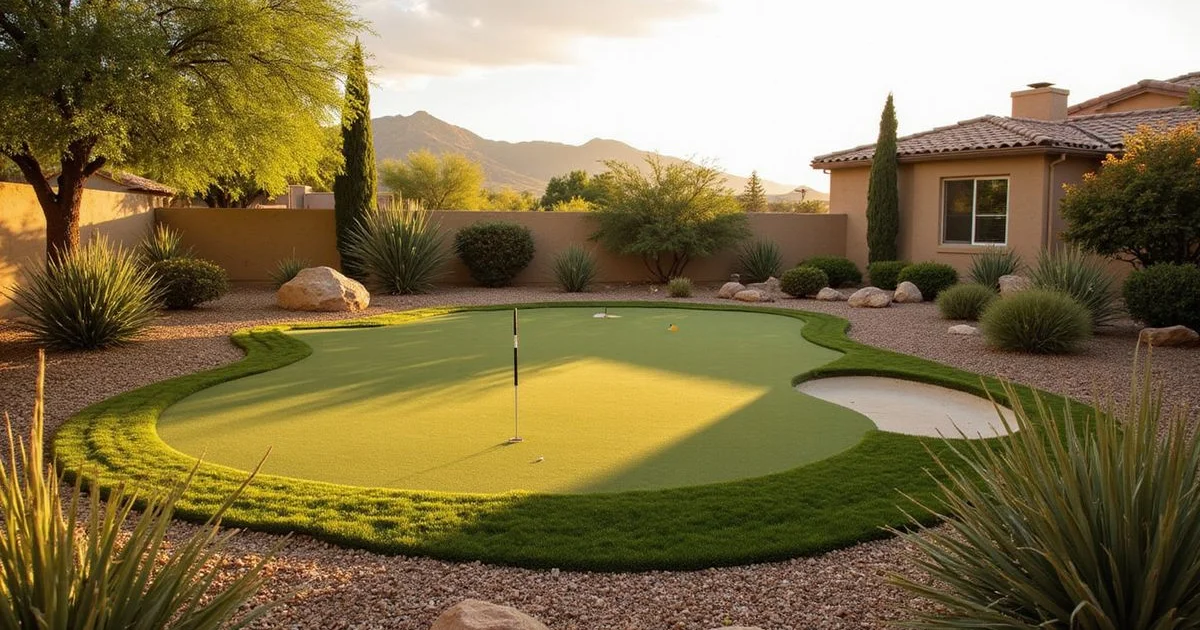
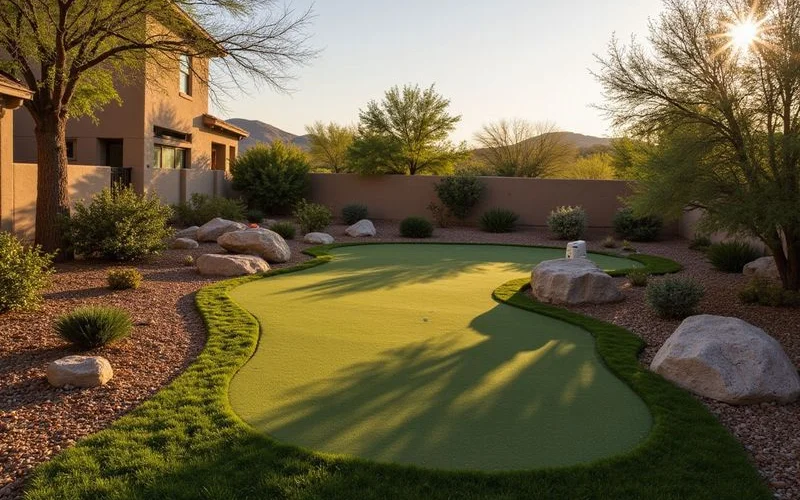
Organic shapes work best here.
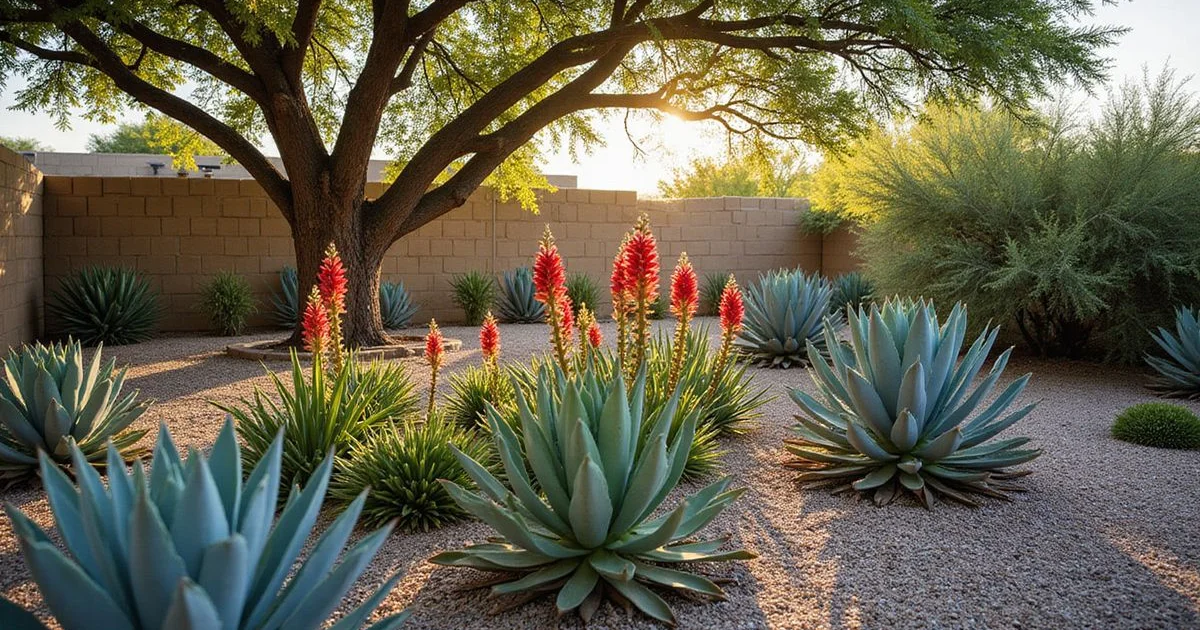
Kidney or bean shapes blend seamlessly with desert xeriscaping, whereas rigid rectangles can look artificial against the natural curves of cactus and boulders.
Pro Tip: Always leave at least 24 to 36 inches of clearance between the green’s edge and any block walls or fences. You need this space to stand and putt comfortably from the fringe.
Choosing the Right Location
Selecting the right spot involves more than just aesthetics.
You must account for the specific environmental factors of the Sonoran Desert.
Sun Exposure and Surface Heat Synthetic turf gets hot. Surface temperatures can reach 160°F or higher in direct July sunlight. We strongly suggest positioning your green where it receives afternoon shade from your home or existing trees, like Mesquites or Palo Verdes.
Drainage During Monsoons Arizona rain is rare but intense. Your green must handle sudden deluges without flooding. We design every green with a 1 to 2 percent slope away from the home and ensure the sub-base is permeable enough to handle flash-storm volume.
HOA Compliance Many Phoenix-area HOAs have strict guidelines. Before breaking ground, you must check your Covenants, Conditions, and Restrictions (CC&Rs). Most associations allow putting greens, but they often require a schematic submission to the Architectural Review Committee (ARC) for approval on setbacks and materials.
Materials and Components
Putting Green Turf
Not all artificial grass is created equal.
Standard landscape turf is too long and soft for golf.
Texturized Nylon vs. Polypropylene We generally recommend texturized nylon or slit-film polypropylene for the putting surface itself. These fibers are short (0.5 to 0.625 inches) and curled to create a non-directional surface. This ensures the ball rolls true regardless of which direction you putt.
Stimp Speed A high-quality installation should target a Stimpmeter reading of 9 to 11. This matches the speed of most public and semi-private courses in Arizona.
UV Stabilization The sun here is relentless. You must verify that the turf product has a high UV protection rating to prevent the vibrant green color from fading to a dull blue-gray within three years.
Fringe and Rough Turf
The “apron” around your green serves a dual purpose.
It frames the putting surface aesthetically and catches errant shots.
We use a high-quality landscape turf with a pile height of 1.5 to 1.75 inches for this area. It creates a realistic “first cut” rough for chipping practice.
Sub-Base Materials
The sub-base is the most critical component of the entire system.
If the base fails, the green develops wrinkles and dips.
In Arizona, we use a specific geological profile for stability:
- Native Soil: Compacted and treated with a pre-emergent herbicide.
- Geotextile Barrier: A heavy-duty weed barrier fabric.
- Aggregate Base Course (ABC): A 3 to 4-inch layer of “quarter-minus” crushed stone.
- Finishing Fines: A 1-inch top layer of smooth crusher fines or silica sand for final shaping.
This combination creates a concrete-like hardness that still drains water effectively.
For summer comfort, ask about “HydroChill” or similar evaporative cooling infills. These specialized coated sands can lower the surface temperature of the turf by 30 to 50 degrees when hydrated.
The Installation Process
A professional crew can typically complete a standard project in 3 to 5 days.
Here is the step-by-step workflow we follow:
Step 1: Site Preparation (Day 1)
The crew excavates the area to a depth of 4 inches. We cap existing irrigation lines and remove organic debris. Important: We always call Arizona 811 (Blue Stake) prior to digging to mark utility lines.
Step 2: Base Construction (Days 1-2)
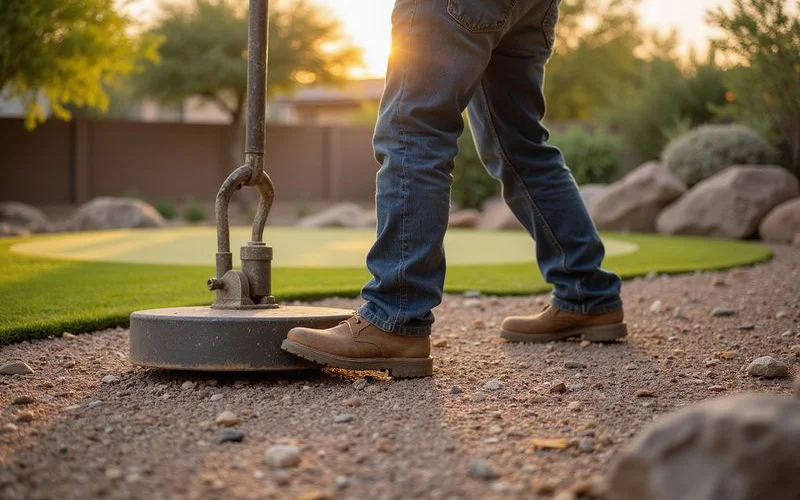
The crushed granite (ABC) is hauled in and spread. We use a vibratory plate compactor to achieve 90 to 95 percent compaction density. This is the stage where we build the undulations and breaks into the green.
Step 3: Precision Grading (Day 2-3)
The smooth top layer is applied. Installers use hand trowels and water to fine-tune the slopes. This is where the artistry happens.
Step 4: Turf Layout and Seaming (Days 3-4)
The turf is rolled out and allowed to acclimate to the heat. We cut the shape and secure the perimeter with 6-inch non-galvanized nails. Seams are bonded with industrial-strength adhesive and seaming tape to ensure they are invisible and won’t separate.
Step 5: Infill and Rolling (Day 5)
A heavy layer of silica sand (roughly 6 to 8 pounds per square foot) is worked into the turf fibers. We use a power broom to drop the sand deep into the matrix. Finally, a heavy water roller is used to speed up the green to your desired stimp reading.
Cost Breakdown
Inflation and material costs have adjusted pricing in 2025 and 2026.
Homeowners in the Phoenix metro area should budget between $15 and $28 per square foot for a professionally installed putting green.
The wide range depends on site access, the amount of grading required, and the premium nature of the turf selected.
| Green Size | Cost Range (Standard) | Cost Range (Premium) |
|---|---|---|
| Small (200 sq ft) | $4,000 - $5,500 | $5,500 - $7,000 |
| Medium (500 sq ft) | $8,500 - $11,000 | $11,000 - $14,000 |
| Large (1,000 sq ft) | $16,000 - $20,000 | $20,000 - $28,000 |
| Custom (1,500+ sq ft) | $24,000+ | $38,000+ |
Additional Cost Factors:
- Cup Lights: LED lights inside the cups for night putting add roughly $250-$350 per hole.
- Sand Bunkers: Excavating and filling a realistic sand trap typically starts at $1,500 depending on size.
- Access: If crews cannot use a bobcat and must wheelbarrow materials into the backyard, labor costs will increase.
Maintaining Your Putting Green
Synthetic greens are low maintenance, not no maintenance.
Here is the realistic care schedule for an Arizona green:
Weekly Care
Debris removal is your main task. Use a leaf blower to clear mesquite pods, palo verde blooms, and dust. Pro Tip: Do not point the blower directly down at the turf, as you might displace the sand infill. Blow across the surface at a shallow angle.
Post-Monsoon Cleanup
Summer dust storms (Haboobs) will coat your green in fine silt. Rinse the green thoroughly with a hose after a dust storm. This flushes the dust down through the drainage holes and keeps the ball roll true.
Annual Tune-Up
Traffic creates wear patterns over time. We recommend a professional “roll and brush” service once a year. A crew will add fresh infill, power broom the fibers back to a vertical position, and re-compact the surface to maintain speed.
If you have pets, rinse the fringe area weekly. While dogs usually avoid the short putting turf, they may use the fringe. An enzyme-based cleaner like “Turf Renu” neutralizes odors instantly.
Enhancing Your Putting Green Design
You can elevate the project from a simple practice pad to a full entertainment hub.
Consider these upgrades:
- Golden Tee Layouts: Design the green with multiple tee boxes (chipping mats) at different distances to create a playable 9-hole course on one green.
- Misting Systems: Install a high-pressure misting line on the patio adjacent to the green to drop ambient temperatures by 20 degrees.
- Drink Rails: Install a bar-height counter or rail along the retaining wall for guests to place drinks while watching the competition.
- Lighted Cups: LED cup lights allow you to practice long after the sun goes down, which is the most comfortable time to be outside from June through September.
Start Building Your Dream Putting Green
A professionally installed green increases your home’s usability and can boost property value.
It transforms a hot, dusty backyard into a functional extension of your living space.
At Surprise AZ Landscaping, we specialize in high-performance greens designed specifically for the Arizona climate. We handle everything from the initial ARC submission to the final roll of the turf.
Contact us today to discuss your vision. We can walk your property, check your soil conditions, and give you an honest assessment of what is possible.

Written by
Alfred D. Mills
Founder & Licensed Landscape Contractor
Alfred D. Mills founded Surprise AZ Landscaping over a decade ago with a mission to bring premium desert landscaping to the Phoenix metropolitan area.
Arizona State Landscape License