Choosing the Right Plants for Your Arizona Landscape
You know how everyone assumes a desert yard is just a pile of brown rocks and a lonely cactus? We see that misconception all the time. The reality is that the Sonoran Desert is one of the wettest and most diverse deserts on the planet.
But 2025 gave us a harsh reminder of why plant selection matters. It was the second warmest year on record for Phoenix. With summer highs consistently pushing past 110°F and rainfall becoming more erratic (we saw a bone-dry July followed by a deluge in late September), your landscape needs to be more than just pretty. It needs to be a survivalist.
From our experience, the difference between a thriving oasis and a scorched yard usually comes down to one thing. It is not about how much you water. It is about choosing the 15 Best Desert Plants for Arizona Landscaping That Thrive in Extreme Heat right from the start.
We are going to break down the exact trees, shrubs, and accents that have survived the toughest summers we have seen in years. These are the specific varieties that save our clients money on water bills and look incredible doing it.
Native Trees That Provide Shade and Character
1. Palo Verde (Parkinsonia species)
The Palo Verde is iconic here, but not all varieties are created equal. We strongly recommend the ‘Desert Museum’ hybrid over the standard Blue Palo Verde for most residential yards.
This specific hybrid is thornless, which makes it far safer for walkways and patios. It also grows rapidly, often adding 2 to 3 feet of height per year. You get that signature green bark and massive canopy of yellow spring flowers without the messier seed pods of other varieties.
2. Desert Willow (Chilopsis linearis)
If you want the look of a tropical escape without the water bill, this is your tree. We love the ‘Bubba’ cultivar because it produces fewer seed pods and stays more compact than the wild native species.
Desert Willow is one of the few desert trees that offers showy, orchid-like blooms. These trumpet-shaped flowers appear in bursts from late spring through early fall. They are a magnet for hummingbirds and handle the radiant heat from block walls better than almost anything else we plant.
3. Ironwood (Olneya tesota)
This is the tree you plant for the next generation. Ironwood is a “keystone species” in the Sonoran Desert. It grows incredibly slowly, often less than a foot per year, but that patience pays off with wood so dense it actually sinks in water.
We use Ironwood as an architectural anchor in large landscapes. Be aware that it does not bloom every year. You might only see its lavender-pink flowers once every 2 to 3 years in May, for a fleeting 10 to 18 days. But when it does bloom, it is spectacular.
Flowering Shrubs That Add Color
4. Texas Sage (Leucophyllum frutescens)
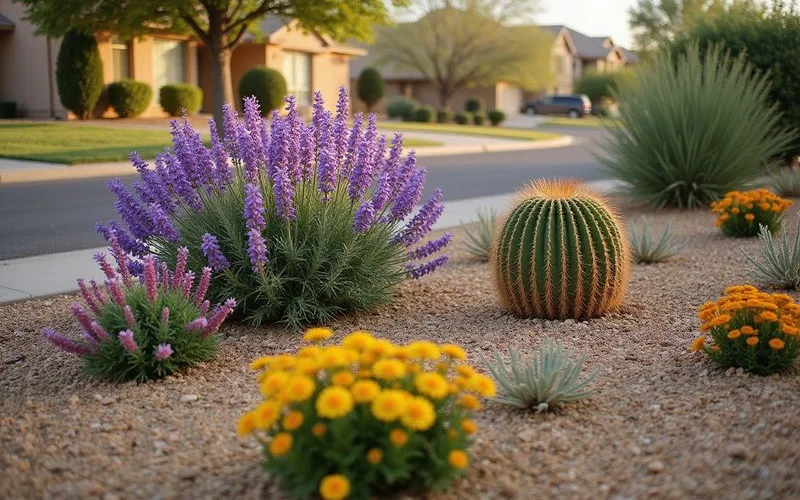
Locals call this the “barometer bush” because it explodes with purple flowers days before a monsoon storm hits, triggered by the rise in humidity. We recommend the ‘Green Cloud’ variety for its deeper green foliage and more reliable blooming density.
You can shape it into a formal hedge or let it grow naturally. It is virtually indestructible once established. Just be careful not to overwater it in winter, as it hates having “wet feet” when the temperature drops.
5. Bougainvillea
Nothing beats Bougainvillea for sheer, vibrant color. But we have one strict rule for this plant: Do not plant it near a pool. The paper-like bracts (flowers) blow everywhere and will clog your skimmer in hours.
Place these against a hot, west-facing wall where few other plants survive. They love the reflected heat. A critical warning for Phoenix residents is to never prune Bougainvillea in the winter. Even if frost damages the outer branches, leave them until spring. That dead growth acts as insulation for the living plant core.
6. Fairy Duster (Calliandra eriophylla)
This is a fantastic choice if you want to attract wildlife. We often use the Baja Fairy Duster (Calliandra californica) because it has deeper red flowers and grows slightly larger than the native pink variety.
The unique “puffball” flowers are available nearly year-round. It requires very little pruning to maintain its natural, rounded shape. It is perfect for that middle layer of your garden where you need consistent color at eye level.
7. Chuparosa (Justicia californica)
Chuparosa is a hummingbird super-food. Its tubular red flowers are perfectly shaped for their beaks. We like to plant these in clusters of three to create a dense wildlife haven.
One fun fact we share with clients is that the flowers are edible and taste like fresh cucumber. It is a deciduous shrub, meaning it may drop its leaves in a drought to save water, but the green stems keep photosynthesizing to keep it alive.
The “1-2-3 Rule” for Watering: Don’t guess with your irrigation. We follow the AMWUA (Arizona Municipal Water Users Association) standard:
- 1 foot deep for small plants, cacti, and groundcovers.
- 2 feet deep for shrubs (like Texas Sage).
- 3 feet deep for trees (like Palo Verde). Buy a soil probe or use a long screwdriver to test the depth after watering. If it hits hard dry soil at 6 inches, you aren’t watering deep enough.
Sculptural Succulents and Cacti
8. Agave (Agave species)
Agaves provide that bold, architectural look that defines modern desert design. Agave parryi (Parry’s Agave) is a favorite for its compact, artichoke-like shape.
But there is a major threat you must know about: the Agave Snout Weevil. This pest is the number one killer of large agaves in Phoenix. We advise treating your agaves with a systemic insecticide every March and September. If your agave suddenly looks wrinkled and droopy, it is likely too late. Prevention is the only cure.
9. Golden Barrel Cactus (Echinocactus grusonii)
We call this the “compass cactus” because mature barrels often lean south toward the sun. These are excellent for adding texture and a bright pop of yellow to your yard without using flowers.
Plant them away from high-traffic paths. The spines are hooked and incredibly strong. They are extremely slow growers, so we recommend buying the largest specimen your budget allows. A 15-gallon barrel cactus can take 15 to 20 years to reach that size from seed.
10. Saguaro Cactus (Carnegiea gigantea)
The Saguaro is the ultimate status symbol of the Southwest. If you want one, you generally have to buy it mature. These giants don’t even start growing their first arm until they are 50 to 75 years old.
Please remember that Saguaros are heavily protected. You cannot just dig one up from the desert. As of 2026, moving a Saguaro requires a permit from the Arizona Department of Agriculture (approx. $7 for the permit + $8 for the tag). Always hire a licensed professional for relocation to ensure it survives the move.
11. Red Yucca (Hesperaloe parviflora)
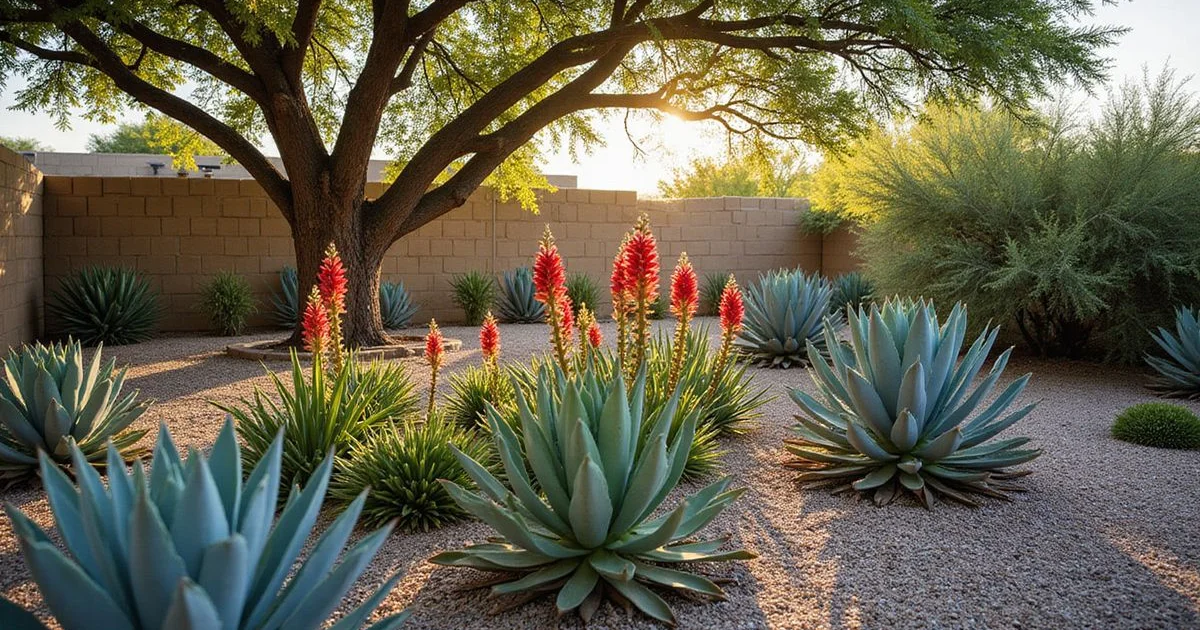
This is the workhorse of commercial landscapes for a reason. Red Yucca is tough, clean, and blooms for months. We prefer the ‘Brakelights’ variety.
‘Brakelights’ produces a vibrant, true-red flower instead of the standard coral-pink. It also stays more compact (about 2 feet tall), making it perfect for smaller residential planters. It is technically not a yucca but related to agaves, which means no sharp dangerous tips on the leaves.
Ground Covers and Accent Plants
12. Trailing Lantana (Lantana montevidensis)
Lantana provides the best “bang for your buck” when it comes to ground cover. A single plant can spread 6 to 8 feet wide. We use the trailing purple variety to spill over retaining walls or raised planters.
Frost will turn Lantana brown and crispy in January. Do not cut it back yet. Wait until you see new green growth sprouting from the base in March. Then, you can cut the whole plant back to about 6 inches high, and it will roar back to life by April.
13. Desert Marigold (Baileya multiradiata)
This is our favorite wildflower for a “meadow” look. The bright yellow flowers sit high on long stems that sway in the breeze.
Be aware that Desert Marigold reseeds aggressively. If you plant one, you will have twenty next year. We view this as a bonus, but if you prefer a manicured look, you will need to deadhead the flowers before they turn into seed puffs.
14. Blackfoot Daisy (Melampodium leucanthum)
Blackfoot Daisy smells like honey when the sun hits it. It is a low, mounding plant that loves rocky soil and intense sun.
The biggest mistake homeowners make here is overwatering. This plant is susceptible to root rot if the soil stays damp. Place it in the hottest, driest part of your yard, give it a little water, and ignore it. It will reward you with white daisy-like blooms all year.
15. Brittlebush (Encelia farinosa)
You have likely seen this plant covering the hillsides along the I-17. Brittlebush has distinct silvery-gray leaves that reflect sunlight to keep the plant cool.
It produces a massive display of yellow flowers in late winter and early spring. We use it to add contrast against darker green plants like Jojoba or Texas Sage. It goes dormant and can look a bit “stick-like” in the late summer heat, but it greens up instantly with the first monsoon rain.
Plant Placement Tips for Arizona Landscapes
Knowing which plants to choose is only half the equation. Proper placement is critical for long-term success in the Arizona climate.
Create hydrozones. Group plants with similar water requirements together. Place the thirstiest plants closest to your home where they benefit from reflected moisture and shade, and put the most drought-tolerant species at the perimeter of your property.
Use the north side wisely. The north side of your home receives the most shade and stays coolest. This is where you can plant species that need some relief from the summer sun, such as bougainvillea and some agave varieties.
Layer your plantings. Create visual depth by placing tall trees at the back, mid-height shrubs in the middle, and low ground covers at the front. This mirrors natural desert plant communities and creates a more cohesive look.
Consider mature size. Always research the full mature dimensions of a plant before placing it. A 1-gallon Texas sage from the nursery will eventually become an 8-foot-wide shrub. Overcrowding is one of the most common mistakes in desert landscape installations.
The best time to plant in the Phoenix metro area is October through March. Getting plants in the ground during these cooler months allows their roots to establish before the brutal June heat arrives. Avoid planting in June, July, or August if possible.
Build Your Dream Desert Garden
The right combination of native and adapted plants can transform your Arizona property from a barren lot into a stunning desert oasis. Whether you are starting from scratch or converting an existing turf lawn to a water-efficient xeriscape, professional landscape design ensures your investment thrives for decades to come.
At Surprise AZ Landscaping, we specialize in selecting and installing the perfect plant palette for your property, soil conditions, and aesthetic preferences. Contact us for a free consultation and let us help you create a landscape that celebrates the beauty of the Sonoran Desert.

Written by
Alfred D. Mills
Founder & Licensed Landscape Contractor
Alfred D. Mills founded Surprise AZ Landscaping over a decade ago with a mission to bring premium desert landscaping to the Phoenix metropolitan area.
Arizona State Landscape License